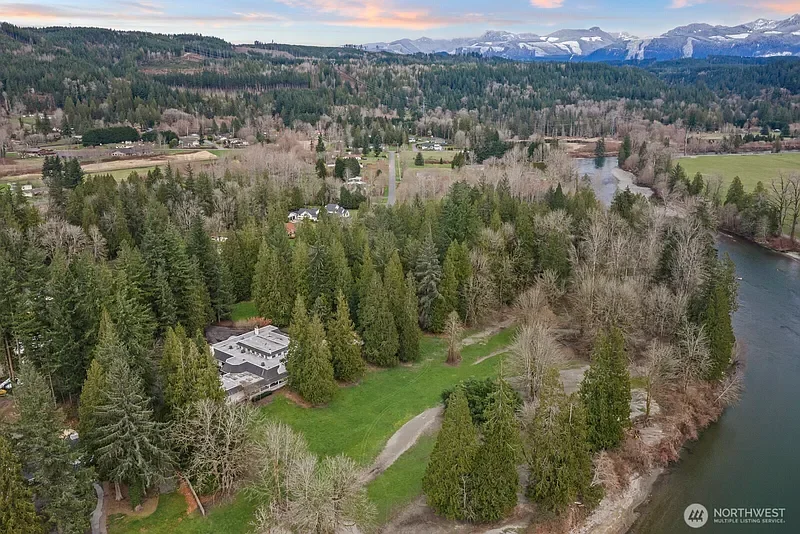
Fall City’s landscape
Where two rivers meet
Fall City sits where the Raging River runs into the Snoqualmie, a mile or so downstream of Snoqualmie Falls. The rivers made this place. They brought people here first, carried the town’s early trade, and still shape where we build, how we farm, and how we handle our water and wastewater.
A crossroads on the river
The Snoqualmie People have lived in this valley since time immemorial. A permanent village called Yelhw stood at the mouth of the Raging River, a rich fishing site. It was one of many Snoqualmie villages along the river and its tributaries. [Confirm the spelling and how the Tribe prefers this described. Ideally run the paragraph past the Snoqualmie Tribe before publishing.]
Settlers later called this spot “The Landing.” Shallow water and rapids made the river impassable upstream, so goods moving up the valley were unloaded here. In the 1880s the valley was a center of hop farming, and Fall City was its shipping point. That ended in the 1890s, when falling prices and an aphid infestation wiped out the crop, and farmers shifted to dairy, poultry, and orchards. The Fall City Hop Shed, built in 1888 and now in Fall City Park, is one of the last physical traces of that era.
A living floodplain
Below the falls, the Snoqualmie slows and winds in wide loops across a broad valley floor. That flat, fertile ground is a floodplain: land the river is built to spread across when it runs high. Flooding is part of how this valley works, and anyone who lives or builds here needs to plan for it.
The Raging River lives up to its name. It’s a steep river that moves a lot of gravel and can shift its channel. King County maps a channel migration zone for the Raging River, which marks the area where the channel is expected to move over time.
Not long ago, river management meant holding the river in place with levees and revetments. Now it increasingly means giving the river room. In 2024, King County finished the Fall City Floodplain Restoration Project, the largest floodplain restoration in county history. It removed more than half a mile of levee and other structures, reconnecting about 145 acres of the Snoqualmie to its historic floodplain downstream of town. Letting floodwater spread out across the floodplain and through side channels improves salmon habitat and also reduces flood pressure on nearby farms, homes, and roads.
Salmon country
The Raging River is one of the core spawning areas for Snoqualmie Chinook salmon. It also supports steelhead and coho. Puget Sound Chinook and steelhead are both listed as threatened under the Endangered Species Act.
Salmon need cold, clean water; gravel to spawn in; and quiet side channels where young fish can grow. Much of what happens on land near the river, from septic systems to lawn care to shoreline plantings, reaches those fish eventually.
What’s under our feet
On a floodplain, the ground and the river are closely connected. What soaks into the soil on our properties can make its way to groundwater and the river. That’s why wastewater matters so much here.
Almost all of Fall City is on septic systems rather than sewers. A well-maintained septic system treats wastewater safely in the soil. A failing one can send bacteria and nutrients toward our rivers and our neighbors. In 2016, a survey found only 14 of 62 properties in the business district had up-to-date septic systems. King County called this a public health risk and a threat to the nearby rivers. The response was a new community septic system for downtown businesses, finished in 2026.
Homes outside the business district still rely on their own systems, and caring for them is one of the most direct things any of us can do for the aquifer and river.
Drinking water in town comes from the Fall City Water District. Its commissioners hold public meetings monthly.